SIA: Self Improving AI with Harness & Weight UpdatesarXiv
A language-model agent that simultaneously modifies task-specific scaffolding and model weights. Achieves 25.1% over prior SOTA on LawBench and 12.4% faster GPU kernels.

AI researcher building Unintellect: small, specialized AI for real business workflows.

4 papers accepted at ICML 2026, held in Seoul, South Korea - including SIA, our self-improving AI system.
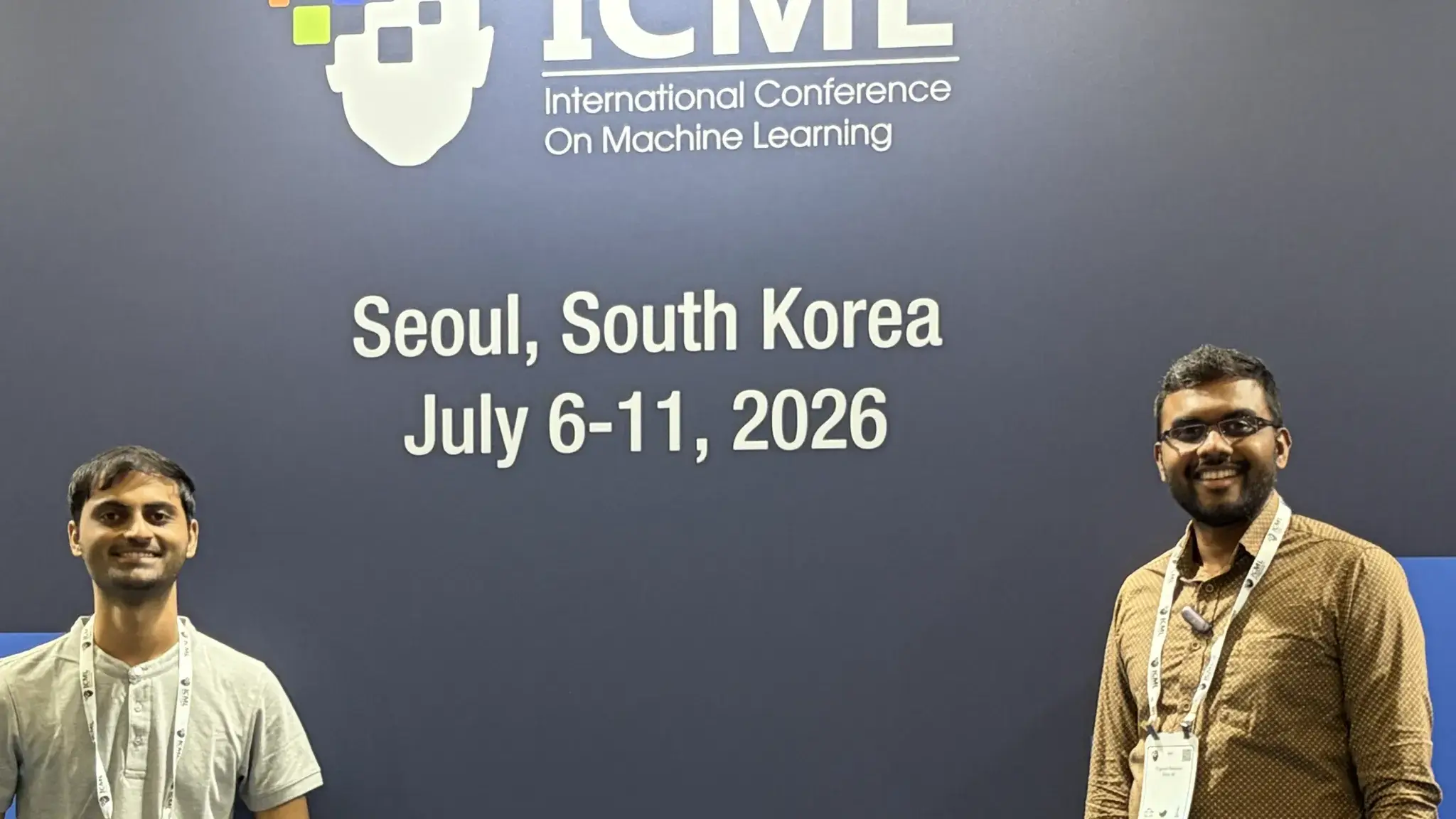
At the ICML 2026 venue, Seoul, South Korea
View all photosI study how to make small language models (SLMs) capable enough for useful work on the hardware people already have. The goal is to make more AI tasks practical on hardware people and teams already have. That work informs what I'm building at Unintellect.
Why small models are a research problem
A smaller model uses less memory and compute, but has less capacity to handle difficult tasks. The research challenge is to improve what it can do within those limits, through better data, training, and inference, so useful work can run on everyday hardware.
A language-model agent that simultaneously modifies task-specific scaffolding and model weights. Achieves 25.1% over prior SOTA on LawBench and 12.4% faster GPU kernels.
Autonomous self-refinement via evolving agent structure and test-time reinforcement learning. +16pp on LawBench, -19% GPU kernel runtime.
Addresses the cost/reliability tradeoff in proxy evaluations. MLEvolve achieved SOTA MAE of 0.1354 on MLE-bench within 12 hours.
A two-agent system pairing a Scientist with an advisor that can only ask questions. Improved Kaggle test scores on 4/5 MLE-bench tasks with a mean increase of ~56%.
A benchmark for evaluating whether an AI agent can modify another agent to improve it, covering meta-improvement and self-improvement scenarios.
Building Unintellect to make AI useful in business workflows, with systems designed around the work they need to do and a focus on speed and affordability.
Leading AI research and high-impact programs end-to-end, from architecture and novel research to production delivery.
Built a real-time AI calling system before audio-to-audio models existed. Engineered low-latency voice pipelines from scratch and took it from zero to revenue.
Organizations I've worked with across AI research, engineering, and product development.

DPIIT

IP India
Bito

Soliton

Atomicwork
Dashtoon